Travel to Greece
Day 2 Cape Sounion - Athens (85 Km.)
(in 9 Km.) Temple of Poseidon: We begin our journey through continental Greece at Cape Sounion. After sleeping and breakfast in Lavrio, we will visit one of the most beautiful temples in Greece, the Temple of Poseidon, built between 444-440 BC. The design of the peripteros temple is a typical hexastyl, that is, it had a front portico with six Doric columns. The temple building was rectangular, with a colonnade on all four sides that encompassed the peristasis. The total number of original columns in the outer colonnade was 34. 15 The columns are still standing today. The columns are of the Doric order.
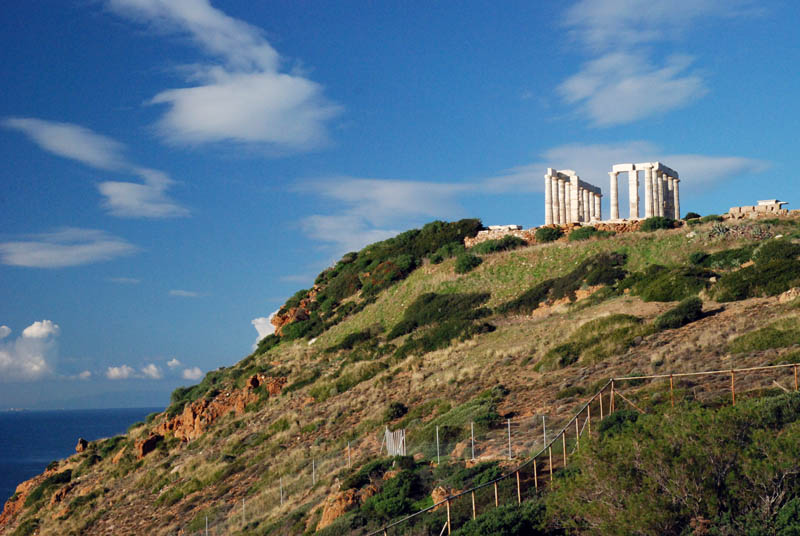
Cape Sounion
They were made of white marble extracted locally at Laureotic Olympus. They were 6.10 m high, with a diameter of 1 m at the base and 79 cm at the top. At the base of one of the columns we can observe the signature of Lord Byron. In addition to the beauty of the temple itself, it stands out for its location, located on a hill about 60 above the sea. The place is also famous for offering spectacular sunsets. A few meters from the Temple of Poseidon was the temple of Athena Sounias, but today there is hardly anything left of it.
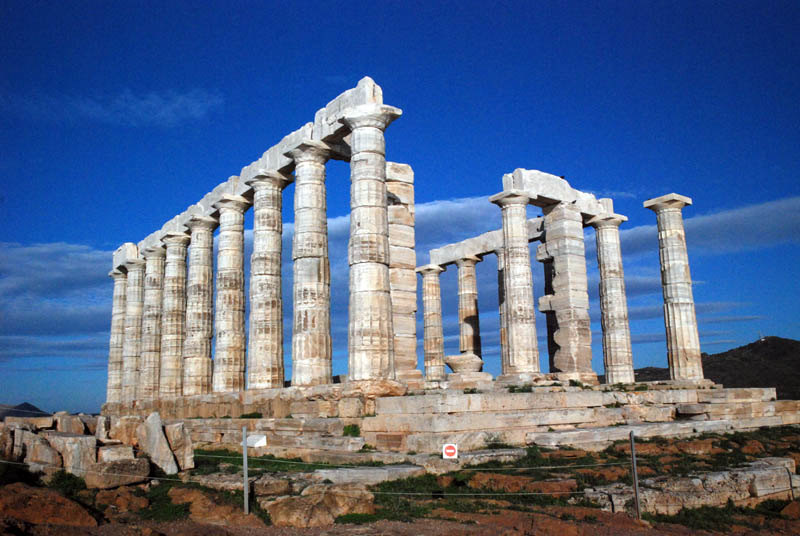
Cape Sounion - Temple of Poseidon
(in 76 Km.) Athens: We begin our visit to the capital of Greece by the Temple of Olympian Zeus (also known as Olympieion). There was the option to buy for € 30 a ticket for several monuments, including the Acropolis and the agoras, but we decided to buy the tickets separately since in winter the price of tickets costs half. The temple was built in marble of Mt. Pentelikon. Although started in the sixth century BC. C., it was not finished until the reign of Emperor Hadrian, in the second century. It was 96 meters long and 40 meters wide. It had 104 Corinthian columns, each 17 meters high. Only 16 of these columns survive today, 13 of them, on the east side, standing. Of the remaining three, on the west side, one collapsed in 1852 and is still lying where it fell. In one of the corners of the exterior of the enclosure we find the Arch of Hadrian, built in the year 131 with marble of the Mt. Pentelikon, Its design is completely symmetrical from front to back and from side to side. The light of the lower level arch is 6.5 meters wide and is supported by pilasters of Corinthian capitals. In the upper one, other similar pillars were placed in the corners of the lower part.
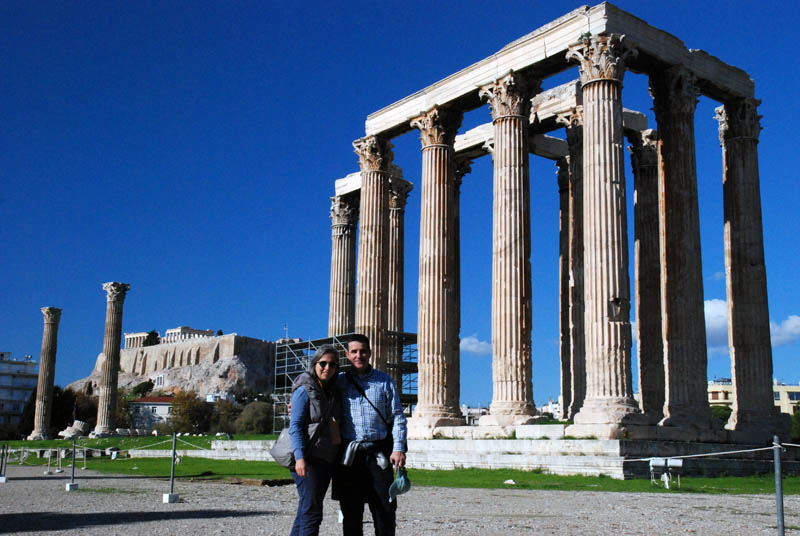
Athens - Temple of Olympian Zeus
We advance on Leof Vasilissis Olgas street until reaching the Panathenaic Stadium, also known as the Kallimarmaro ("beautiful marble"), an athletic stadium that hosted the first edition of the Modern Olympic Games in 1896. Rebuilt from the remains of an ancient Greek stadium, the Panathenaic is the only important stadium in the world built entirely of white marble (from the Mt. Pentelikon) and one of the oldest stadiums in the world. In ancient times, it was used to house the athletic part of the Panathenaic Games, in honor of the goddess Athena. During the classical era, the stadium had wooden seats. It was rebuilt in marble, by Lykourgos (Lycurgus) c. 330 BC and was enlarged and renovated by Herodes Atticus, in the year 144 AD, with a capacity of 50 000 seats. It currently has a capacity for 45,000 spectators.

Athens - Panathenaic Stadium
After crossing through the park where it is the National Garden of Athens and the Zappeion, we arrive at Syntagma Square or Constitution Square. The square is presided over by the Greek parliament and the Tomb of the Unknown Soldier, decorated with an evocative relief of a dying Hoplite soldier. The square was inaugurated on March 25, 1932 during the "Independence Day". The tomb is flanked by texts from the famous funeral prayer of Pericles. The other walls of the square are covered with bronze shields that celebrate military victories since 1821. The National Guard (Evzones) continuously patrols in front of the tomb, dressed in their famous fustanella uniforms and tsarouchi. We stayed to see the change of the guard that is done every hour.

Athens - Syntagma Square (Changing of the Guard)
Since Syntagma square starts Ermou street, a pedestrian zone and the city's best-known and busiest shopping street. With fashion shops and shopping centres promoting most international brands, it is in the top five most expensive shopping streets in Europe. In the junction with Kapnikareas street we found a small square where is located the Byzantine Church of Panaghia Kapnikarea, one of the oldest churches in Athens. It is estimated that the church was built some time in the 11th century. If we had continued by Ermou street we had reached Monastiraki neighbourhood. Instead of that, we went to the left, where we saw the Metropolitan Cathedral of Athens and the neighborhood of Plaka.

Athens - Church of Panaghia Kapnikarea at Ermou street
Between Ermou Street and the Acropolis we find the Plaka neighborhood. It is considered the most attractive and colorful area of Athens. It is a neighborhood that after the period of Ottoman occupation, in which the regular urbanization (typically Greco-Roman) was destroyed, was urbanized without planning, adjusting to the relief. This has given rise to a neighborhood of labyrinthine streets, in many cases narrow and sloping, that are packed with taverns and restaurants. The biggest attraction is walking through its streets, full of shops, such as in Adrianou Street. Among its tourist attractions is the Choragic Monument of Lysicrates, erected by the choregos Lysicrates in 335/334 BCE to commemorate the award of first prize to one of the performances he had sponsored.

Athens - Plaka neighborhood
In the upper part of Plaka we find the small neighborhood of Anafiotika. Anafiotika´s houses were built in the mid-19th century by a population of bricklayers from the island of Anafi, in the Cyclades, who moved to Athens for the construction of King Otto´s palace. It is therefore a typically cycladic neighborhood, with small one-story houses, with strong white and blue colors, perched on the hillside and forming winding alleys. We end the day having fabulous dinner at the Scholarhio Restaurant.